info@assignmenthelpers.co.nz
 +64 9889 1881
 By
Imagine learning how to run a business without reading a marketing chapter; instead, you create a small campaign, promote a real product, analyze customer responses, and understand what works and what doesn’t.
Also, in your environmental science course, you spend the entire day collecting water samples from a local river instead of rote memorizing definitions from textbooks. This learning based on projects, experiments, and role plays is known as experiential learning.
“Experiential learning is the process of learning through hands-on experience and reflection, and is more narrowly defined as ‘learning through reflection or doing.” It is a lot different from traditional rote and didactic learning in which a learner takes a passive role.
Traditional classroom learning is also crucial, as lectures, textbooks, presentations, and discussions help students with foundational knowledge. However, knowing about something is not the same as knowing how to apply it. In that regard, experiential learning closes that gap by providing students with opportunities to turn knowledge into action.
For students in the contemporary world, this approach works best as employers now look for graduates who can solve problems, communicate effectively, work in a team, adapt to changing situations, and also apply their knowledge beyond examinations. However, this concept has its roots in ancient philosophy. Let’s get into the details of experiential learning!
What Is Experiential Learning?
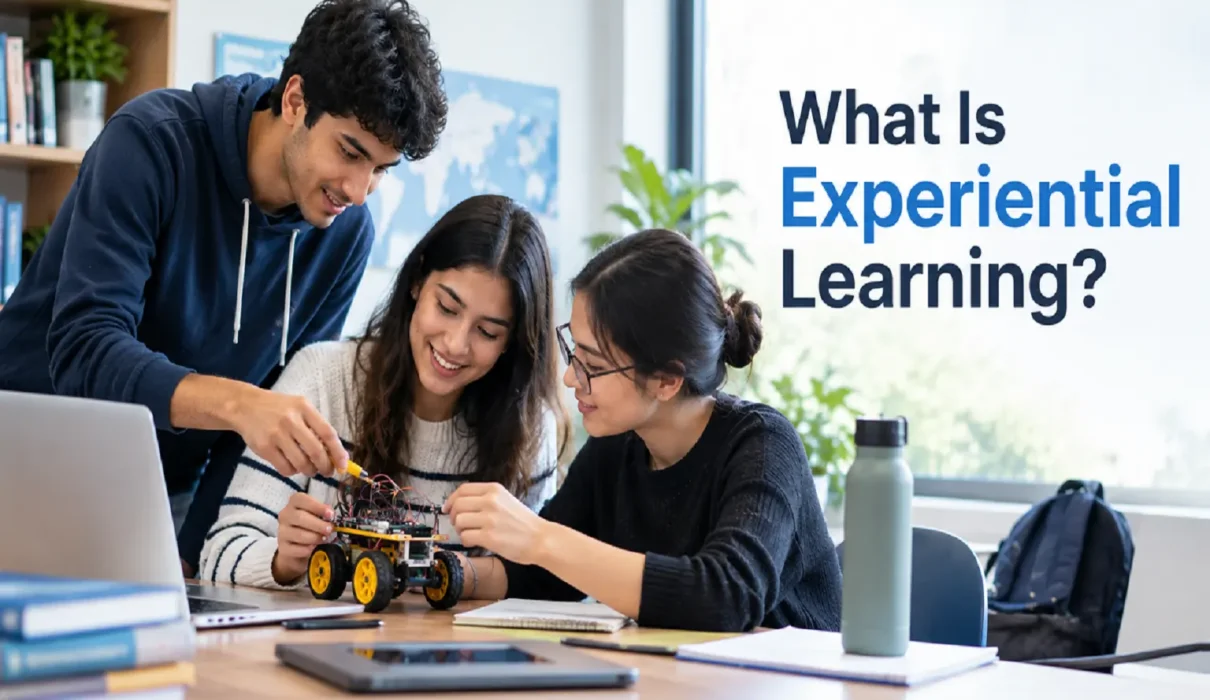
In simple words, experiential learning is an educational approach in which learners learn by doing and reflecting on their actions. The experiential learning synonyms are hands-on learning and learning by doing.
The major difference between experiential learning and traditional learning is that experiential learning extends the role of a learner to an active participant instead of a passive learner.
Instead of simply listening or reading a concept, experiential learning involves activity, performance, problem-solving, decision-making, and then also reflecting on what happens.
However, beyond experiences, it also involves thinking about the experience and understanding what it teaches.
The combination of action and reflection is what makes experiential learning complete.
Top examples of experiential learning include:
- Role-playing or simulations
- Project-based learning
- Field trips
- Experiments
How Did The Concept Of Experiential Learning Develop?
The concept of experiential learning is rooted in ancient philosophy when Aristotle wrote in his Nicomachean Ethics: “For the things we have to learn before we can do them, we learn by doing them.”
However, this concept got formalised in the late 19th and early 20th centuries as a reaction against rigid classroom environments.
Then, John Dewey added to this concept by asserting that classrooms should mirror real life, and later Jean Piaget further added that children construct cognitive frameworks through hands-on interactions with their environment.
Furthermore, in 1984, American psychologist David Kolb combined the ideas of Dewey, Lewin, and Piaget into the modern Experiential Learning Model.
What Are The Stages Of Experiential Learning?
Kolb’s experiential learning cycle demonstrates learning as a continuous cycle with four stages:
- Concrete Experience: it is the direct experience of a student gained through senses and perceptions. This involves completing an internship, experimenting, participating in a field trip, and working on a project or problem-solving.
- Reflective Observation: in this step, the student makes sense of the concrete experience by thinking about what happened. They consider what went well, what went wrong, how they responded, and what they observed.
- Abstract Conceptualisation: in this step, the student links experience to theories, concepts, principles, and existing knowledge. It also involves drawing conclusions and forming new ideas or rules.
- Active Experimentation: In this step, the student uses what they have learned to tackle a future situation differently. For example, after knowing what caused a problem in the project, the student may avoid it in the project.
David Kolb’s Experiential Learning:
Experience → reflection → understanding → experimentation→ new experience
What Are The Top Examples Of Experiential Learning?
These are some experiential learning examples:
- Role-Playing Or Simulations: Not every experience can take place in the real world. Therefore, students can also recreate real-world scenarios and practice realistic situations in a controlled environment. Some examples: medical students practicing clinical scenarios, law students conducting mock trials, business students participating in negotiation simulations. It is useful in developing communication and decision-making skills.
- Project-Based Learning: Project-based learning involves working on a task over an extended period and solving open-ended and real-world problems. For example, business students create a complete business plan for a hypothetical company. They will have to conduct market research, identify competitors, develop a pricing strategy, create promotional material, estimate costs, and present proposals.
- Field Trips: Field trips actually take learning beyond the classroom and provide students with the opportunities to interact with different people, communities, environments, etc. Students visit museums, businesses, hospitals, historical sites, courts, factories, environmental sites or research facilities. The physical environment helps students to interact with concepts in real life, making it easy for them to understand complex concepts.
- Experiments: Experiments involve students testing concepts through direct observation and experimentation. For example, students perform a reaction rather than simply memorizing it from a book. Lab experiments also teach students that the real world involves many factors that can change the expected results.
- Internships: Internships involve students working in a professional environment to learn the application of classroom theories in the real world. For example: a marketing student working on social media campaigns.
- Case Studies: Case studies involve students working with real-world problems. It also involves students researching and analysing theory and ultimately reaching a conclusion.
- Community Service: Another example of experiential learning is community service; it allows students to use their knowledge and also contribute to society. It may involve students teaching underprivileged students, participating in environmental projects, and conducting awareness campaigns.
- Research Project: Research projects are a powerful form of experiential learning. They encourage students to develop questions, correct information, analyze evidence, and draw conclusions.
- Group Activities: Group projects can also become experiential learning when students solve problems together. This also involves dividing tasks, communicating ideas, managing disagreement, meeting deadlines, and so on.
Learning Management System (LMS) can also help support and deliver experiential learning by blending digital tools with action-based activities.
If You Are Struggling With An Experiential Learning Assignment, Then Don’t Worry.
Let our writers handle the task for you, as they are available 24/7.

Why Is Experiential Learning Important For Students, And What Are Its Benefits?
If you are wondering why experiential learning is crucial for students, then let me tell you. As a student, everyone hears the words theory and practice, and it is experiential learning that brings these two elements together.
We all know that applying a concept to real-world situations can be complex. Now think of a nursing student studying patient communication. It will be easy to read about the topic, but learning to interact with a patient involves a lot more than just knowing techniques. Practical experiences help students encounter challenges in a controlled learning environment. Experiential learning can assist students to:
- Apply academic knowledge
- Develop practical skills
- Improve problem-solving skills
- Become more confident
- Understand complex concepts
- Develop communication skills
- Improve teamwork
- Become more independent
- Prepare for professional environments
Furthermore, it makes learning more meaningful.
The Benefits Of Experiential Learning For Students:
1. Better Understanding Of Complex Concepts:
Some concepts seem complex to understand in an abstract form. Therefore, experiential learning becomes useful as it gives students something concrete to connect with.
For example, understanding supply and demand by running a small simulated marketplace can make the relationship between consumer behavior and price easy to understand.
2. Improved Problem-Solving Skills
Analysing situations, assessing different perspectives, evaluating options, and making decisions help students to develop independent thinking.
3. Great Confidence:
Experiential learning also provides students with greater confidence. For example, when they complete an experiment or handle an internship task, they become confident in their performance in such situations.
4. Better Retention & Understanding:
Application of theory to practice helps students retain information and gain an in-depth understanding of concepts.
5. Learning From Mistakes:
One of the most important aspects of experiential learning is the opportunity to make mistakes and learn from them.
6. Strong Communication Skills:
Experiential learning also develops communication skills in students by providing them with opportunities such as role-plays, teamwork etc.
7. Better Collaboration & Teamwork:
Professional environments do not involve working in isolation. Therefore, experiential learning activities teach students to collaborate with people who possess different personalities, opinions, and working styles.
8. Improved Critical Thinking:
Experiential learning helps students develop critical thinking skills by performing activities and learning how and why something works.
Tips To Implement Experiential Learning:
For Teachers:
- The first tip involves knowing the prior knowledge and preparedness of students.
- The second tip involves preparing experiential learning activities that align with learning objectives.
- During experiential learning activities, the teacher must play the role of facilitator and mediator.
For Students:
- Students must set clear learning goals about what they want to learn from their experience, for example: whether they want to improve communication, understand a theory, or develop professional confidence, etc.
- Stay actively involved during the experiential learning activity.
- Keep a reflection journal with you to record everything about the experience.
- Connect theory to experience: this is crucial so that you learn to apply theories and concepts to the activity and experience.
- Ask for feedback: ask your teachers, supervisors, and teammates about what you could improve.
What Are The Common Challenges Of Experiential Learning?
The Common Challenges Of Experiential Learning:
- Lack Of Resources: Some institutions do not have enough equipment, funding, industry partnerships, or faculty to provide students with opportunities to perform experiential learning activities.
- Fear Of Making Mistakes: Some students are not interested in experiential learning as they avoid taking risks.
- Unequal Participation In Group Work: Experiential learning activities result in only one student doing most of the work.
- Time Management: Experiential learning activities require a lot of time. Therefore, students must balance experiential learning with lectures, assignments, exams, and personal tasks.
- Difficulty In Reflection: Some students struggle to make sense of experiential learning activities and what they learned from them. Therefore, you must ask yourself, after completing an experiential learning activity: what happened, what it means, and what you would do differently next time.
Experiential Learning Vs Traditional Learning:
Experiential learning doesn’t mean traditional learning is unnecessary or not useful. Instead, these two approaches complement each other.
Traditional learning involves focusing on understanding information through lectures, textbooks, readings, discussions, and examinations, and experiential learning involves focusing more on applying that information through experiences and activities.
The strongest education combines knowledge and knowing how to use that knowledge.
However, students first need to learn foundations, and then experiential learning gives them opportunities to apply, test, and question some foundations.
Final Thoughts:
Experiential learning is a learning approach and method that helps students to learn through experiences and then turn them into knowledge through reflection and application. Some of the common examples include internships, projects, experimental field steps, community work, etc.
It helps transform knowledge into practical ability, mistakes into lessons, and classroom learning into real-world understanding.
FAQs:
1. What Are The Benefits Of Experiential Learning?
These are the benefits of experiential learning: better knowledge retention, stronger problem-solving skills, enhanced self-awareness, improved soft skills, and career readiness.
2. What’s The Definition Of Experiential Learning?
Experiential learning is an educational method where students gain knowledge through hands-on experience and reflection.
3. What Is Dewey’s Experiential Learning?
Dewey’s experiential learning is a theory that states that people learn best through active engagement, hands-on experience, and critical reflection. The core principles include: learning by doing, reflective thinking
4. What Are Some Examples Of Experiential Learning Activities?
Experiential learning activities, internships, field trips, role-playing, and service learning.
5. What Is The Experiential Learning Approach?
The experiential learning approach is an educational approach that involves learning by doing a reflection on experiences.
6. What Is The Experiential Learning Cycle?
The experiential learning cycle is a four-stage cycle that explains how people absorb, process, and transform practical experiences into lasting knowledge.
7. What Is The Definition Of Experiential Learning?
Experiential learning is an educational method in which students gain knowledge through direct, hands-on experience and reflection.
8. What Are The Top Examples Of Experiential Learning?
These are the top examples of experiential learning: internship, service simulation, project-based learning, fieldwork.
9. What Is Experiential Learning Meaning?
The meaning of experiential learning is an educational method in which students gain knowledge through direct, hands-on experience and reflection rather than traditional passive listening
10. What Is The Experiential Learning Model?
The experiential learning model is a continuous four-stage cycle. It demonstrates that people learn by doing, reflecting, thinking, and testing new ideas. David Kolb popularized this framework in 1984.
11. What Is An Experiential Learning Synonym?
Synonyms for experiential learning include hands-on learning and learning by doing
12. What Is Kolb’s Experiential Learning Cycle?
Kolb’s experiential learning cycle is a four-stage cycle created by David Kolb that demonstrates how experiences turn into lasting knowledge. It includes 4 steps: Concrete Experience, Reflective Observation, Abstract Conceptualization, and Active Experimentation.