info@assignmenthelpers.co.nz
 +64 9889 1881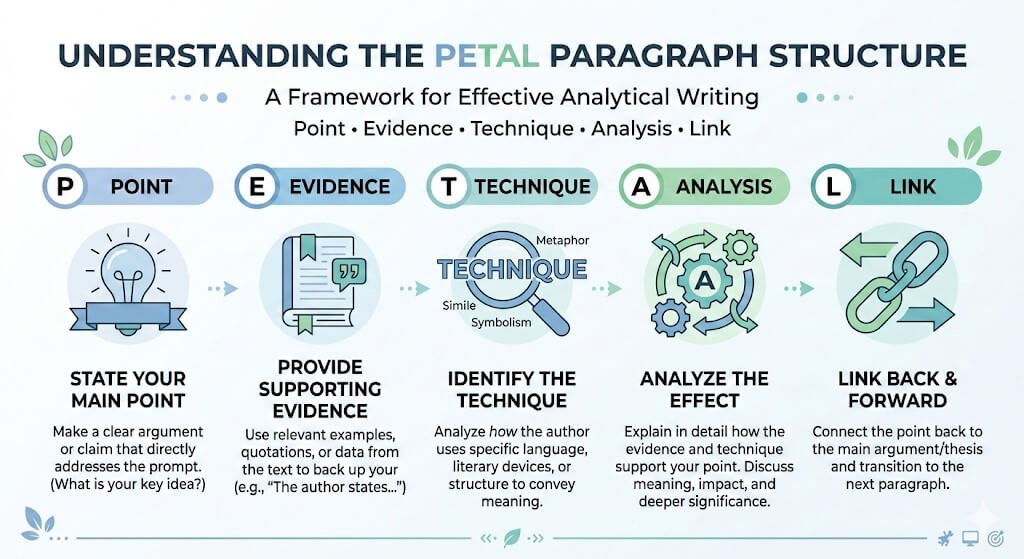
 By
By The strong academic writing completely depends on structured analysis. The Petal Paragraph approach can help pupils present their evidence and interpretation in a logical, examiner-frinedly format.
Moreover, it is widely used in English essays across New Zealand secondary schools and universities. This structured method can help you strengthen clarity, argument depth, and critical thinking.
Additionally, a well-developed Paragraph makes sure that every claim is supported by the textual evidence and has a detailed explanation. Instead of just listing the quotes without any proper insights, pupils can apply a systematic framework that links ideas directly to the essay question. The result you get is organized, analytical writing aligned with NCEA and university assessment standards.
In this blog, we will discover what a Petal Paragraph is, why it matters, and how to write one. So, make sure to stick to the blog till the end.
What Is A Petal Paragraph?
Research from the New Zealand Qualifications Authority shows that high-achieving NCEA English responses demonstrate sustained analysis. Moreover, the structured argument development. The petal writing technique directly supports this expectation.
Understanding what a petal paragraph is begins with its acronym. A p.e.t.a.l paragraph stands for:
- P – Point
- E – Evidence
- T – Technique
- A – Analysis
- L – Link
Furthermore, the Petal Paragraph’s meaning centers on analytical depth. Also, each section has its own importance function.
- Point: Introduces the argument relevant to the essay question.
- Evidence: Provides a quotation or textual reference.
- Technique: Identifies the literary device or stylistic feature.
- Analysis: Explains how the technique shapes meaning.
- Link: Connects the idea back to the essay thesis.
Many pupils often wonder what “petal” means in practical terms. Well, it represents a local progression from claim to interpretation. This structure is valuable, especially in literature-based essays where critical insights matter the most and can affect your grades.
Petal Paragraph Structure Explained:
Following the Petal Paragraph structure ensures that there is a balance between evidence and commentary. Furthermore, many students lose marks because they summarise instead of analysing. That’s where the Paragraphs come in. It prevents those issues.
Petal Paragraph Structure Example:
Here is an illustrative example of a petal paragraph structure for a literary text:
- Planning: The author introduces the concept of ambition as a destructive one.
- Evidence: Vaulting ambition, which goes over self.
- Technique:
- Analysis: The metaphor makes the analogy between ambition and an uncontrolled leap, implying self-destruction and recklessness. This analogy supports the ethical after-effects of uncontrollable lust.
- Connection: This description helps prove the essay’s thesis: that ambition results in ruination.
This example of Petal Structure shows how each element contributes to analytical richness. Without the analysis section, the paragraph would be descriptive rather than evaluative.
According to research by the University of Auckland Academic support services show that using a structured paragraph improves coherence and grades in first-year essays.
Pro Tip: If you are having a tough time writing a Paragraph, consider seeking guidance from the Assignment Writing Services in New Zealand. They have essay experts who can help you write solid essays.
How To Write A Petal Paragraph Effectively:
Students are always on the hunt for how to write a perfect Petal paragraph that scores excellent grades. The only key is that you need to structure it properly.
How To Begin A Petal Paragraph?
When writing a Petal Paragraph, make sure to begin with a narrow statement to the essay question. Avoid vague statements. Rather, make sure to write a clear sentence that interprets what you are talking about. For example:
- Bad start: The writer employs techniques.
- Powerful opening: The writer employs symbolism to attack social inequality.
What Is Analysis On A Petal Paragraph?
The problem with analysis in a petal paragraph is that many students fail to grasp what it is. Analysis describes the mechanism and reasons for how the technique forms meaning. It should:
- Examine word choices
- Explore connotations
- Discuss emotional impact
- Connect to themes
Good petal analysis is more than just recognising. Instead, it constructs their meaning within the broader writing.
Petal Writing Structure vs Other Essay Methods:
The Petal Writing Structure is elaborative as compared to PEEL (Point, Evidence, Explanation, Link). Having this definite technique in a petal paragraph, students show that they engage deeper in the text.
Following the Petal Writing Structure is considered effective in:
- NCEA Level 1–3 English essays
- Literary analysis tasks
- Film analysis assignments
- Humanities essays in universities.
According to the Education Review Office, structured analytical writing enhances consistency in assessment and achievement levels across various secondary schools.
Example Of Petal Paragraphs For Practice:
If you want to understand the Petal Paragraphs better, have a look at this example. You can write your essays using this format.
Point: As the director shows isolation is something emotionally harmful.
Evidence: The character is isolated in an empty space of a wide frame.
Technique: Cinematography- wide shot.
Analysis: The shot is wide, reducing the character’s presence and supporting the visual aspect of vulnerability and loneliness. The sense of emptiness within the space makes people feel even more emotional.
Connection: This helps support the essay’s argument about the psychological impact of isolation.
Analysing several samples of petal paragraphs will give one the confidence to use the petal format in writing.
Petal Paragraph Format & Presentation Tips:
When it comes to formatting the Petal Paragraph, the structure should flow easily. Moreover, examiners want you to integrate the real-world scenarios and examples rather than just assumptions
Here is what you need to do:
- Make sure to integrate your quotes smoothly and reference them properly using the correct style.
- Furthermore, do not shorten the analysis of evidence.
- Also, maintain academic and formal tone throughout the essay.
- Make sure each of your paragraphs must relate with the thesis.
Students who are working on lengthy assignments like a 2000-word essay, then you should use Petal paragraphs throughout the body to maintain clear arguments. If you want to learn more about how Petal Paragraphs can prove to be powerful, consider reading our blog: Brilliant Ways Petal Paragraphs Can Be a Powerful Tool for Writers.
Case Study: NCEA Level 2 Student Improvement
A Year 12 student in Auckland improved his grade from average to excellent after restructuring his essays using the petal technique. Here is how he did it:
First, quotations were used without explanation in the paragraphs. Once the petal paragraph structure was used, the analysis doubled in length, and the connections to the thesis were made clear.
The feedback provided by the teachers pointed to more effective critical thinking and better flow of the arguments. The internal assessment grades improved by 18% within a term. This transformation demonstrates that the petal writing method improves measurable academic outcomes.
Why Petal Paragraphs Improve Academic Results:
Using the structured writing frameworks, like Petal paragraphs, can help you achieve better results as readers can understand what you are talking about.
A study conducted by the University of Otago Writing Centre has shown that the coherence of the analytical essays by students who use guided paragraph structures is higher.
Benefits include:
- Logical argument flow
- Reduced repetition
- Clear textual engagement
- Attentive examiner bias.
The petal essay approach makes sure that every paragraph has a direct contribution to the thesis instead of going off track to a summary.
Ready To Strengthen Your Essays With Expert Guidance?
Mastering the Petal Paragraph technique can help you transform analytical writing from basic description to high-level evaluation. Whether you need personalised academic support, structured essay planning, or expert editing guidance, consider seeking help from the professionals at Assignment Helpers NZ.

Conclusion:
This brings us to the end of the guide. The Petal Paragraph framework is a clear approach for analytical writing. Furthermore, it aligns perfectly with NCEA and university expectations.; By applying the complete petal paragraph structure like Point, Evidence, Technique, Analysis and Link, students can move beyond summary. Moreover, they can show their critical thinking. Remember that each paragraph has its own purpose, which helps keep arguments focused and evidence makes a greater impact. Also, mastering this paragraph can elevate your grades.
Frequently Asked Questions (FAQs)
1. What Is A Petal Paragraph In Simple Terms?
Ans. It is a structured analytical paragraph using Point, Evidence, Technique, Analysis, and Link.
2. What Does Petal Stand For?
Ans. Point, Evidence, Technique, Analysis, Link.
3. How Is Petal Different From PEEL?
Ans. Petal includes a separate technique section, strengthening literary analysis.
4. What Is Analysis In A Petal Paragraph?
Analysis explains how the technique shapes meaning and connects to themes.
5. Can Petal Paragraphs Be Used In University Essays?
Yes, especially in humanities and literature subjects.
6. How Long Should A Petal Paragraph Be?
Peal Paragraph should be approximately 150–250 words short, depending on essay length.
7. Is The Petal Paragraph Suitable For NCEA Exams?
Yes, it aligns with NCEA assessment criteria.
8. What Is A Petal Paragraph Structure Example?
A structured paragraph including a claim, a quote, a device, an explanation, and a thesis link.
9. Should I Label PETAL In My Exam?
No, integrate it naturally into your writing.
10. Can I Use Multiple Techniques In One Paragraph?
Yes, if they support the same analytical point.
11. What Is The Petal Paragraph Meaning In Academic Writing?
It represents a structured analytical framework.
12. Does Petal Format Work For Film Analysis?
Yes, it supports both written and visual text evaluation.